The Idea of User Centered Design (UCD) is a very effective method in making designers get off their butts and really have a feel for the subect they are edesigning for.
In a smalle extract by David Benyon, author of : Design Interactive Systems, he comments on the 4 pay offs of UCD.
1: Design process involving the user is more likely to meet satisfaction before the product is launched.
2: Reduce user errors to ensure safety of product while reducing costs for warranty or repairs.
3: Desinger and user develop a better understanding and will be able to make design more ethical.
4: To focus products on user could help designers better understand cultural devirsities.
In other words, I think that UCD is a great practice to have designers meet a better job satisfaction for one: being able to leave their seats na dreally talk too people, and two: for a designer to really emerge themselves in to a given task.
Here in Hong Kong, I don’t think I have ever seen good UCD being carried out… the most ive experienced seem more manditory, and were carried out because “someone told us to do so”. In fact, the further we are in to this course, the more I realise how important it is to hit the right questions, to set up scenarios for the client to answer to and most of all in becoming more aware of trends that are happening in my society. Very often, trends and latest happenings are pushing users to lean towards one thing or another, for example: Covid-19 has grounded many to be working at home, and while some restaurants were taking a beating, food delivery services has met with emence popularity for people keen on keeping social distancing, and even now that all seems to have been returning back to normal, Food Panda and Deliver Roo are both still doing really well.
Leading on to my example. I ordered almost every single day during my 2 month period working from home, Food Panda really got me there with their selection and how turned-off I was in leaving home for the super market and the fact that my apartment is still a mess after my move. The interesting thing though is the other side of the delivery box, the people that find a good part-time job in delivering for Food Panda.
It was recent when a friend and his wife who worked as a repair’s man and an air stewardess have left their jobs (or maybe lost their jobs), and when I visited them at their studio/ flat, I was amazed to see a Food Panda uniform laying on a table, ” Yep, we started doing delivery and they pay well! Just 2,3 hours I have earned $250!” ($25 pounds). They then excitedly started showing me their app , “for us who are very in to fitness, this is like the perfect job to keep an income.”. Then it started occurring to me that this is something totally new: not only the ones receiving the food got an app that is designed to give you discounts, recommend you restaurants and make it all as user-friendly and as convenient as possible; but then the ones doing the delivery is also well considered for and this is a big chain of organised service.
Then one fine evening my fiancees’ cousin dropped by, he works as a freelance driver of some sorts and drives his clients’ children to school. As we sat in our living room making a Food Panda order, the topic came up and right on my lap to input on my findings, “There is a ranking system with drivers,” says Ho Man, “the ones that are rank one have a wide range of around 7 sets of shifts to choose from and other benefits; compared to the lowest rank with only 1 shift a day assigned. It all depends on timelyness and customer ranking.”.
There are little details such as how the deliverymen/ women get paid, flexibility provided for those who might want to do delivers in another district, protocols of how complains are handled etc. Before all this, restaurants did their own delivery, only limited to homes and offices that are nearby for one of the staff or waiters to make the delivery by foot. Now Food Panda has not only taken apart this whole restaurant to customer relationship, they have even created a whole new job opportunities and has included these freelance employees as an essential part of their app design and system.
Rohid Chadda, co-founder and MD of Food Panda has this to say about hiring employees (https://rohitchadda.com/tag/interview/):
“Young entrepreneurs often rely on their gut while making business decisions and while intuition can sometimes be an indicator of something being afoot, it certainly isn’t an appropriate criterion to rely on when hiring employees. Don’t let yourself get wrapped up in just the ‘culture fit’ – often, a candidate’s ability to click with you has no bearing on the professional skills he/she brings to the table. Instead of going ahead with casual interviews to gauge someone’s vibe, create structured interviews and evaluate each candidate on merit. Ultimately, this will ensure you build a strong team to grow your business.”.
Heres’ more by Rohid regarding Food Panda (https://www.businesstoday.in/):
” I would break it up into placing the order, and then processing the order. Placing the order doesn’t take time. How much time the restaurant takes to prepare and deliver the order depends on the restaurant. If the order doesn’t get delivered on time, he can either go to the restaurant or come back to us. We believe that the customer is a Foodpanda customer. So we make sure the restaurant delivers on time. Based on performance, we keep filtering the bad restaurants that are not honouring the delivery times. (Foodpanda has now started its own delivery service in Hyderabad, Delhi, Mumbai, Pune and Bangalore)…..It is the customer-centric approach. We selected the right sort of restaurants and made sure we weeded out the bad ones. It is the focus on customer experience that helped us grow very quickly.”.
These insights have solidified my speculation of the delivery staff having been apart of Food Panda’s considerations. Through learning more about Mr. Chadda, there could be a hand-full of UCD methods that could be identified :
1: Focus groups
2: Usability tesing
3: Questionnaires and Interviews
4: Customer journey maps

The method Id like to focus on would be Customer journey maps. There is no direct evidence leading to certain application of the method to Food Panda, yet the order process goes : Choose a restaurant, filling out the order forms, payment, restaurant gets the order starts to prepare, while a delivery man is to pick up the order, once the food is picked up a GPS map shows the location of the delivery man/ woman and communication by texting is made available on both sides to ensure smooth delivery to one’s doorstep. Which is clearly a well thought out process with the visuals to go along with. Other extras include : Recieving a coupon code to encourage usage, and customer service in handling incidents such as wrong orders, spillage or having delivered to the wrong destination, which is usually resolved by a full refund.
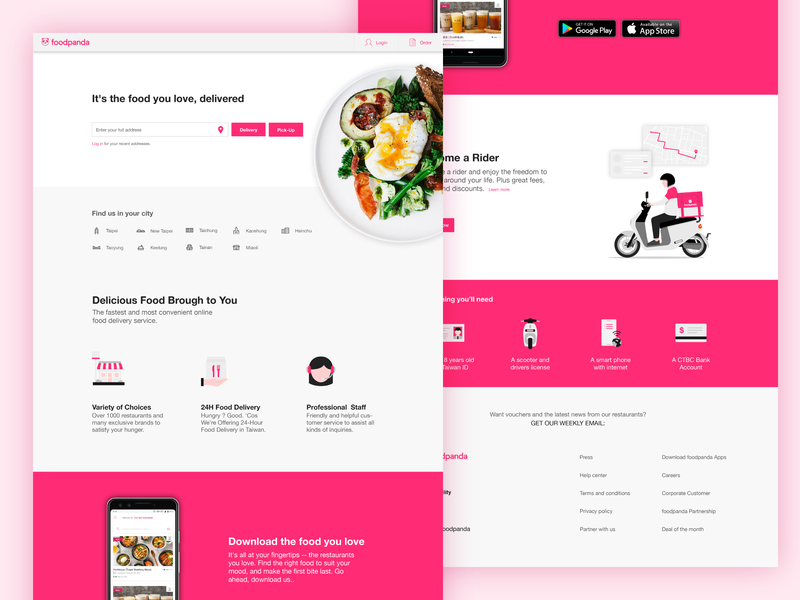
Such an intricate process could only mean one thing : trial and error. I have strong reasons to believe that Food Panda has gone through long development processes. With Rohid Chadda himself quoting the term “user-centered” many times, I do believe that the popular app was developed by applying lots of UCD methods and processes.
ANDY WAS HERE
 ANDY was here 🤓