Here I would like to share something personal that’s been going on with me.
I have been needing a break for what is going on around me: I have broken from a 4 year relationship last month, and in a week’s time has found a new apartment and moved all my belongings right in to it.
I called the breakup and did not feel much about it at first, but being the 1st time living alone, the tiredness and having followed another’s lead in the past years have made me come to a realisation that I have lost myself in this confusion.
I would admit that I am in a depression of some sorts (i know because I have been there before), but then I believe that it’s nothing I cannot handle myself and I need to learn to deal with my emotions.
The first thing I am realising is that I need time by myself and distant from my friends for a while; too many of them in this situation would drink or party away and they would encourage me to do so. It is a very easy route to take in making people feel better in the short-run; but in the end it is obvious that problems cluster, one does not recognize their own flaws in numbing away and in the end not only do they become rigid, they also lack the ability to handle themselves properly. So as a practice I forced myself to stay home to do some thinking on my own.
Secondly, I had ALOT going on, my head is filled with: what ifs, what should I do with myself, the flaws and mistakes i’ve committed. They’ll pop up right before I sleep and every morning when I wake up. So in these floods of thoughts going through my mind, I started writing them down and I found that in doing so, I have left those anxieties at a place in a clear, organised manner and that actually helped me grasp my reality a lot better, not having to revisit anything that is already on record so to say.
I need time, but it’s probably time that I don’t have. Thinking about this as a teacher, graphic designer or even a student though, in official’s eyes my own flux in emotions is nothing of an excuse unless it’s so severe I could get a doctor’s note or something right? Still, I noticed my over sensitivity needs to be controlled if I am to become successful and a full mature adult, during this time I found out that emotionally I have certain skills that are lacking, I found myself very immature in these aspects.
I cannot conclude this blog by saying : I am feeling a lot better now. No, I cannot explain everything here or would those things matter, but for the mean time and carrying on with this course, I would need to learn to deal with it and keep my head strong.
Tedman Lee is a very close friend of mine, we have known each other for a good decade, played in the sameband, that I have seen him through days working as a staff at a 4A company to starting up his own company, nowhaving established himself as a music video director, owner of his own brand and is a public figure in Hong Kong’s trap-house/hip hop scene.
This is one of those interviews where I knew we were to sit down for drinks. Despite knowing each other so well, it was after the interview we both exclaimed how great it was and that we have never sat down in discussion upon a topic as such. It was insightful as much as it was fruitful, I would even dare say that having conducting this interview has improved our friendship even more, unexpectedly it was only then when I actually found out that we actually hold very simular values towards all the events of 2019 and how we are planning to tackle what is ahead.
TL : Tedman Lee ME = Andy
ME :
Please introduce yourself
TL :
I am a multimedia creative running my own agency under the name Triple Happiness Club. I started from directing music videos, fashion videos and some brand consultancy for foreign brands wanting to enter HK.
I threw parties and around 2016 I started managing a young artist named Young Queenz and I also started DJing and advising a collective of musicians under the name Wildstyle. Shortly after I then started the clothing brand Private Label and through the label I started injecting more of my values/vision with projects that are more artistic in order to explore different varieties of expression. Now that bigger brands are digging in to a more undergro und tone for their campaigns, they’d seek me out for advice and to work on projects together.
ME :
Would you be able to explain why the big brands have this interest for an underground tone?
TL :
Everything is a Tipping Point (a book by Malcom Gladwell), I think that Hong Kong has reached it’s tipping point, everything takes time and that it is an organic growth. Compared to other cities, Hong Kong as an expensive, commerce based international city, and in a place like this there are a lot of set ways of doing things, and when we pitch something out of the ordinary to clients back in the day they worried about their audience not being able to catch on : too underground too niche. Foreign campaigns come to me with a set of expectations and most of the time I was just there to directly meet their demands.
Lately though, the word that is heard the most from these clients is the word : community. Let’s be honest though : how “community” can a brand get? In order to achieve this, they would need someone like me who is active in community (ies). A community is not just some short term project but instead it’s grown naturally out of a collective of people. This kind of changes the working conditions in the sense that I am no longer just executing under their instructions but I get to add my thoughts and visions in making the projects unique.
I think with social media being as big as it is now with it’s varying crowds, brands then tend to look for representatives on these platforms and it’s effective in the sense that they are able to directly speak and make their influence on these already established communities.
ME :
What do you think of the young audiences that you and your friends/ artists draw? How did you build this crowd?
TL :
It took us time. When we first did our trap-house parties, there were kids that were 14 years old that turned up, having successfully kept them around, we have these older kids that are able to spend money alongside another generation of newcomers, this took us a long time to build.
ME :
What are the differences in doing what you do before and after 2019?
TL :
I can only say that we tend to be more careful with the content we make, but that does not mean the end. As someone much older has told me : When there is unlimited space you can do whatever you want ; but when space is limited that is when one’s wits are really being tested. I think it’s actually fun to create with limitations, it makes it more challenging.
It doesn’t matter where you are, we are always being monitored as long as we are on the internet. If you just let yourself go and do whatever you want, there is the risk you would be upsetting others ; everyone is keeping an eye on one another. To play it smart is what matters.
Culture has always been created or at its strongest under social unrest. Hong Kong post-2019 actually triggered people to start supporting local culture and its products. In the 70-80s there was the disco culture and all these parties introducing gay culture, fashion and music in to HK, back then everyone only valued imports from abroad. Then came the 90-00s when the very commercialised local pop scene dominated and they were in a hurry to rack that cash in. Now, in this post-commercial era it is up for grabs, many local indie bands have been selling out especially with the global pandemic having ground everyone seeking entertainment while being grounded in their own homes or the city itself.
Back to the lack of “space”, many poems we have heard and most national anthems were written during time of war. Now, there are these people that become scared and they would decide to immigrate somewhere else, I think they lack this mentality; but on the flipside, there are those that would think that this might be their prime creative years. Remember there is the need to be patient, everything that is rushed doesn’t last for that long, we are closer to that right timing to be creating and launching projects but whatever that is, it should be enduring and expected to last for a long time.
ME :
What is your advice to citizens here?
TL :
Its an open field, everyone should try their best to pursue what they want. My main focus is to spread more positive energies and help those around me out when they seek advice. You can never guess that something you did might end up having a huge impact on other individuals.
We should never tell people what to do, our job as creatives is to set examples or set an atmosphere for the audience to have it figured out for themselves. Like a painting hanging in a gallery, everyone would view and think of it differently, there is no pleasing everybody.
ME :
What’s wrong with our government in pursuit of developing culture?
TL :
The government just simply needs to listen, to the people and to communities. We seem like we are bound by the traditional thinking of “the old guy is always right”, when I grow old I want to be the guy that listens and not one to be telling people what to do. There is a bit more to listening too, one is to consider these comments being received and have the goal of producing something beyond that in order for people to feel satisfied.
Hong Kong is a beautiful city with architecture that reflects the people’s straight, uniform characteristics and I feel that this a fact that we have ignored, there is also the mis-understanding on the government’s behalf failing to recognizing that the older parts of Hong Kong is what is driving most tourists to come see this city. We have the conditions to keep these relics while also developing these modernised attractions.
It really depends on the people, Hong Kong people are used to not having an identity, people don’t have much of a city pride. If there’s a core value to Hong Kong people is that we have no personality and have always been used to serving the needs of others. People need to learn to love this place first. That’s why I think things are looking a bit better with 2019 having created a small hint of pride and unity.
Reflection
It was a lil’ afterwards that I encountered something personal that was very upsetting. I dealt with it by myself for the longest time until one day I was sitting at Tedman’s studio and was having a chat about what I was feeling and how to be dealing with them, and again: Only then when I found out we hold very simular values and even experiences having grown up.
It was interviewing this buddy I have known for so long that I have discovered how many things are being left out when things are left unmentioned.
For the longest time I thought I was pretty much alone in beliefs for a more united Hong Kong under all this political confusion ; the relationship problems that I encounter as a 34 year old that I think were too immature to express and kept to myself for some time…then VOILA, here is someone that has the same opinions, who has experienced the same feelings and you have been seeing him every other week for the past 10 years without knowing it.
Interviews are interesting in a way that it opens up topics one wouldn’t regularly bring up in day to day conversations, but through doing this practice for the past months it was a window in to some untouched, unquestioned aspects of someone else’s life. I have asked certain questions in the past months with the response : ” that is a good question”, “I don’t think anyone has asked me that before”.
So again, i’ve always turned my work mode on and still expect really proper results. This interview with my buddy Tedman has really changed how I look at interviews, but sadly this should be the last interviewee on my list and I am glad it ended on a high note.
So having talked to Stuart, I realised that the original idea of wanting to cover the topic of news, all it’s outlets, distribution plus the changes it has gone through in the past couple years is too big a chunk to swallow with too broad of topics to cover. After some guidance and instructions, I have now decided to set my sights on social media, during and after 2019’s Anti-Extradition Law Amendment Bill Movement instead.
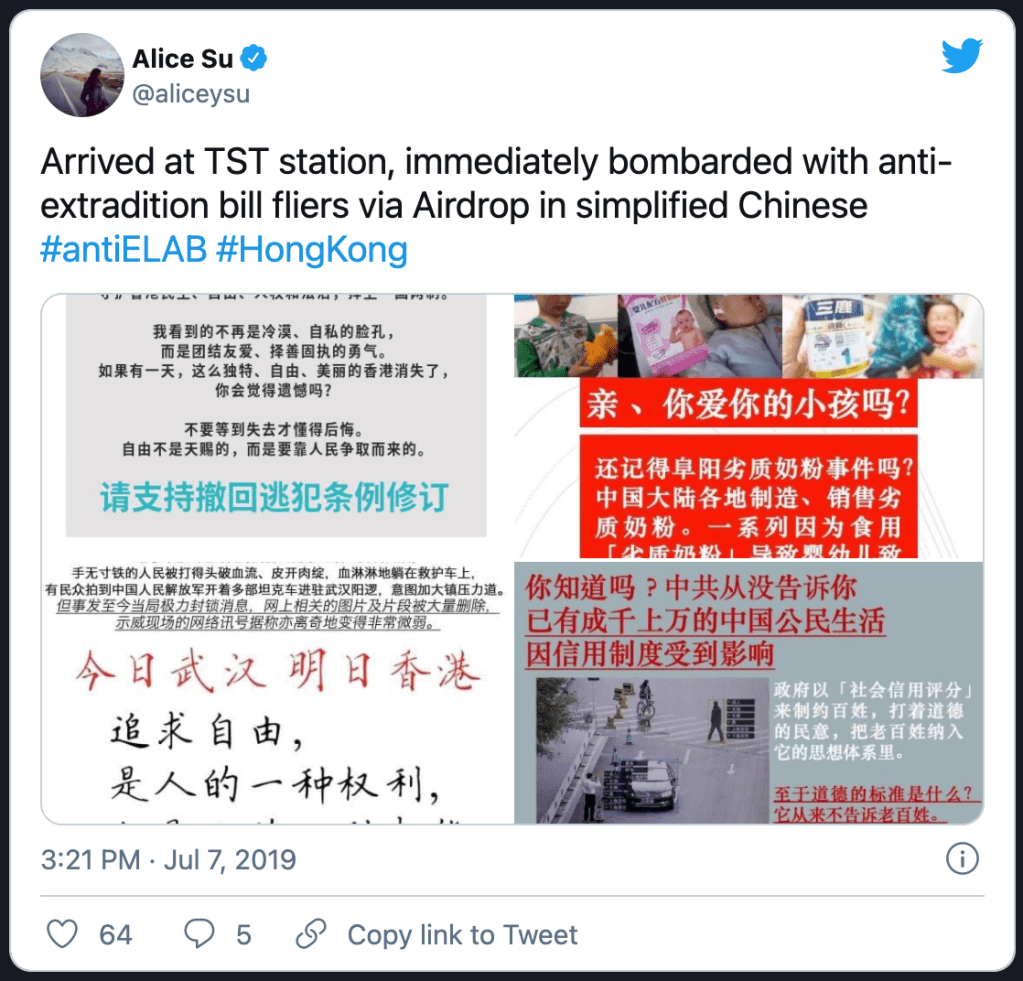
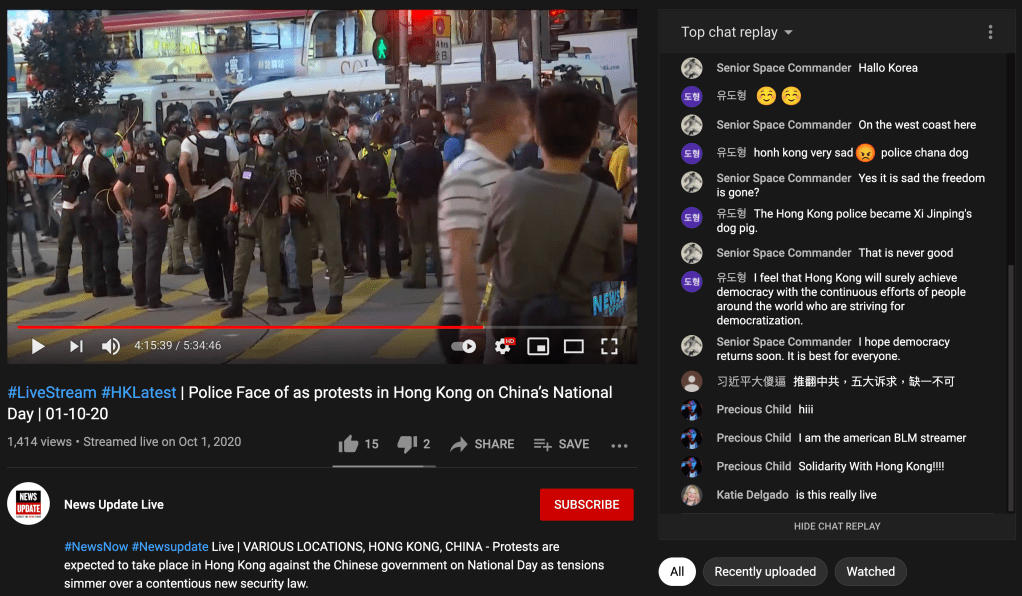
There are many interesting aspects including how people received news and information, the rise of live feeds, leaving comments and emojis, notifications on smartphones, a distrust in the mainstream networks, the divide in society (Yellow and Blue) and also protestors having used iPhone features such as Airdrop in passing messages in order to stay under the radar.
posted by Twitter user Alice Su on recieving political material via Airdrop in 2019
live stream of protest with comments section on the right
It’sStill News
At first I was really concerned about having to gather a whole new set of research, but having looked in to the interviews that I have already done, of course there are questions that would be considered off topic right now, but then the positive thing is that there is relevant material in all interviews that were conducted.
The previous interviews and research might not have specifically focused on the topic of social media, but all interviewees have mentioned the use of social media as a source of distribution. News as one of the most sought after material of them all, a lot of the previous work is still pretty much relevant moving forward from now on, for example:
–Moment Hung has shared his experience in resolving an issue as a civil journalist on the Clubhouse app.
–Jenny, the anonymous protestor has spread messages and vital protest information retrieved from multiple forums and social media platforms via Telegram groups.
-William Pang has been assigned as a camera man to provide instant live feed to be posted on their Facebook page.
So despite the sudden shift in gear having send an instant panic down my spine, after having analysing what I have on hand it is not so bad after all! If anything all the interviews and books I have read and translated are still very much relevant, and if not the “old” research based on news media can still serve as a good comparison of media and it’s methods old and new. Rest assure that taking the dig in to news as a base understanding actually is going to benefit the essay writing later on.
To be honest, despite having relflected upon the many preperations to take before conducting an interview, the following interview was one of the least fruitful of them all. I thank Nam for taking his time, there were pieces that were useful to the essay writing and material that was inspiring.
What happened was that I have stepped in and asked for this interview during what must have been his “peak season”. The interview itself has been prosponed multiple times due to his tight scheduel and long working hours, and that when we finally managed the time to conduct this interview over the phone it was during Nam’s bus ride home after work.
Despite him being the most looked forward to interview on my list of interviewees, I have came to realise that no expectations should be had before interviewing anybody of any caliber. He could’ve simply been tired or from what I might have gotten being a distant friend of his : he has always been someone that is not that chatty to begin with. Also, Nam’s take on the future of journalism is very bleak, at one point he even mentioned that : he is not sure if he would still be able to keep his job the next day.
My disappointment is actually a big : what if? Maybe if I caught him on a better day this might have been a better interview? But all in all this could be a lesson learnt in not to settle with an interview after a busy day at work, or maybe, the gloominess that was observed is infact what is going on with the mainstream media today with all the clamping down the HKSAR government has been doing, and Nam is definately one that has been affected by these newly established laws the most.
A Thankyou To Nam
Despite being an interview I hold regrets upon, I would like to take note of a warning given to me by Nam when I first approached him.
When I first told Nam that I want to base my paper on the news and how media has changed during and after the 2019 protests, he straight up told me that no news media groups or even universities have the courage to discuss a topic as such now-a-days.
This made me think and did hesitate a little, but I believe that as long as my intentions and goal is to discover or set a path towards social balance, my search should always be kept more technical based and dissecting events. Let this be a reminder to myself in not walking the line and putting myself in dangerment of the laws in place.
I have Nam to thank for having bring these considerations up.
Former Editor at 01 News,RFA Local Journalist
CN = Chan Yun Nam ME = Andy
ME:
What are the differences in workflow before and during 2019?
CN:
It’s more dangerous in the sense of legal limitations, journalists could be targeted as individuals just for doing their job.
ME:
Are there any precautions the journalists have to take in reporting these happenings?
CN:
Not much, the workflow was pretty much the same. There were more outings for sure and late nights at the office.
ME:
HK01 is web based in nature, what’s the difference between that and formerly working for a Oriental Daily (newspaper)?
CN:
I don’t think there is an obvious difference aside from the fact that the content not having to be printed. When events are urgent, we would still have to quickly react and be quick on our feet.
ME:
HK01 as an online news outlet, do you guys pay attention to any of the direct feedback in front the public?
CN:
I don’t really pay attention or mind anything that is said about us as journalists, there might be a small amount of pressure on us in general be we have learnt to kind of ignore them and focus on our job.
ME:
The news now are fueled by a lot of bias and emotions, what are your thoughts?
CN:
I simply think of it as characteristics of individual news firms. In general, I don’t think that the professionalism of HK news reporting is not that bad at all compared to other Asian places.
ME:
Can you please define professionalism and provide some examples of Asian cities that don’t do as well?
CN:
The effort we put into seeking truths and facts is far greater than places like Malaysia and Taiwan.
ME:
What are some extra considerations you guys would make in order to sell your “paper” more effectively?
CN:
Well yes, but the main point is not in selling papers, the goal is in how we could write and publish in a more simplified manner making it easier for readers to digest and how to make articles go viral, that is the job of a journalist.
ME:
How is this achieved?
CN:
For example if we are creating content on Facebook, what to write and what photos to use in attracting attention.
ME:
How would you rate the quality of Hong Kong readers?
CN:
They are not too bad. My motto is to “not treat readers as idiots” and I am communicating through my own respectable medium. As I said before, every platform (forum or social network) has their unique traits and characteristics, and I don’t allow those biases and comments to strive me away from what I need to do and my point of view.
The things said on the internet in general are pointless, there are no responsibilities to bear. I tend to distance myself away from those.
ME:
Do you think there are things that could be done to improve such a trend?
CN:
These comments come from platforms that are owned by big corporations and there is nothing we can do to change that. There is a difference in general tone and content between mass media and smaller platforms : smaller ones do tend to dig in to higher value meaningful conversations while mass media comments are usually just very black and white. Again these do not and should not affect me as a professional.
The generation now have grown up and are accustomed to the internet, they have a good idea about taking everything they get with caution.
ME:
People now have the choice of getting their news from individual hosts or YouTubers, are there any concerns about that?
CN:
I think what I do is different from what YouTubers provide. We are the first providers and the hosts having read what we produce, read and comment on top of our work. All societies need journalists to produce news material, it is a post that will always exist.
ME:
Last question, with the establishment of the National Security Department, are you guys provided with clear rules of what to or not to publish?
Jenny is actually not named Jenny at all. A close friend of mine, she has chosen to remain anonymous due to arun in with the police during the protest, which have moved her from the front line of the protest to back-end support, coordinating and had to pay close attention to different situations, outbreaks via social media and live coverage broadcasted by medias big and small.
J = Jenny ME = Andy
ME:
You were very active during the demonstrations, what were your duties like?
J:
When it all started in June I only joined the protests as a regular citizen, unfortunately I was booked by the police not able to leave an area on curfew, causing me to not being able to join that many protests.
As the demonstrations went on, there was a realization of the lack of safety precautions amongst protestors, we started utilizing the more secure communication app : Telegram for trading news, vital information and safety tips, it even later on became a source in collecting donations for funding the proper gear for younger protestors who can’t afford such things.
As a result of the political disputes, some teenagers left their homes over heated arguments and there were those nice enough to offer temporary shelter for these individuals.
ME:
What kind of groups were there, could you name some?
J:
On Facebook, there was one started just for this purpose named PPPN, Tseung Kwan O Beacon (將軍澳 烽火台), Youngspiration (青年新政) etc.
There are 2 kinds of groups/ forums, one is kind is known as “open sea” (公海) where all sources of information are provided by members and the public ; another is the kind when information was released only by the host of the forum.
ME:
Then there’s Telegram, Dropbox and AirDrop, any others?
These methods were improvised by people on LIHK all according to the needs of the situation.
Instagram was not used so much for the nature platform itself is too personally attached.
ME:
Many changes in news reporting : celebrity anchors and live streaming being a couple of them, what are your thoughts?
J:
Live streaming in June 2019 at the beginning of the protests was not as advanced and lagged a lot. As the situation carried on for months to come, the tech started to catch on better. I think that live streaming is healthier or better for HK audiences for viewers are to witness and come to their own conclusions as events unfold in front of their eyes. Yet, relatively new towards such a large scale event the population were really sensitive during that period, which they would have to start learning what has news value and what is worth a thought and to be debated about, opinions were literally flying through the air.
When it comes to online content, the amount of articles made available are to the point of a flood (Jenny being a person to read articles from both ends). Forums are farming not just content but fueling emotions which creates a lot of confusion resulting in big groups of blind followers. The gap between blue and yellow is still widening today due to individuals expressing deep selfish thoughts triggered by emotions. The city is in chaos.
ME:
Do you feel that members of these online communities can be trusted?
J:
I only trust members in familiar groups. There is always the risk of people with a hidden agenda ratting out everyone if we ever get to know each other on a personal level, whole groups of people could get arrested.
Do not trust the internet, only under the right circumstances and with a clear head.
ME:
Now that the demonstrations are being clamped down on to a stop, what are the significant changes that are left from the events of 2019?
J:
More in context than any physical happenings, people are now more conservative and would much rather be on the receiving end and would not expressing much opinion.
For forums and other online sources, pages are more a collective of opinions from the public. Citizens have clearly developed a sense of public awareness, even the greater news media firms are more dependent on online content generated by the public.
ME:
What and how are we to be aware of and improve on?
J:
There are a few things:
-I think people can now start turning off their notifications, especially on Facebook, someone is now shoving content down our throats and that is not a good sign.
-There is too much discussion based on emotions and not enough talk about how to actually solve problems.
-The public eye is ever more sensitive towards the media, the police force and the government.
-Many citizens out of distrust are solving problems by themselves.
-News reports now will always hold a bias whether it is obvious or not, rendering the mainstream media ineffective. People turn to Youtubers and other individual platforms as such and are too heavily relying on these hosts to do their thinking for them.
Ever since the handover of 1997, there have been problems that need answering, such as : The definition of 1 country 2 systems? Where do our core values lie? Debates and discussions about how and who should govern Hong Kong.
Reflection
This is one interesting interview compared to all the previous interviewees who were involved in the news industry themselves. Jenny was a user and not just an ordinary person sitting on their couch observing the news, Jenny at one point was putting the information she recieved from network television, social media and forums in to use in a way which could affect the safety of protestors that relied on her for vital updates and guidence.
Jenny as someone who is younger than I am, made me feel a little off beat with what is going on with Hong Kong society today. She is a person who would jump on the latest app, read what is going on in forums big and small and has a good view in what the population is thinking about.
Reflection On the Political Environment
The winds of the protest or any kind of “resistence” has died down due to the strong hand the government has put on to assure national security.
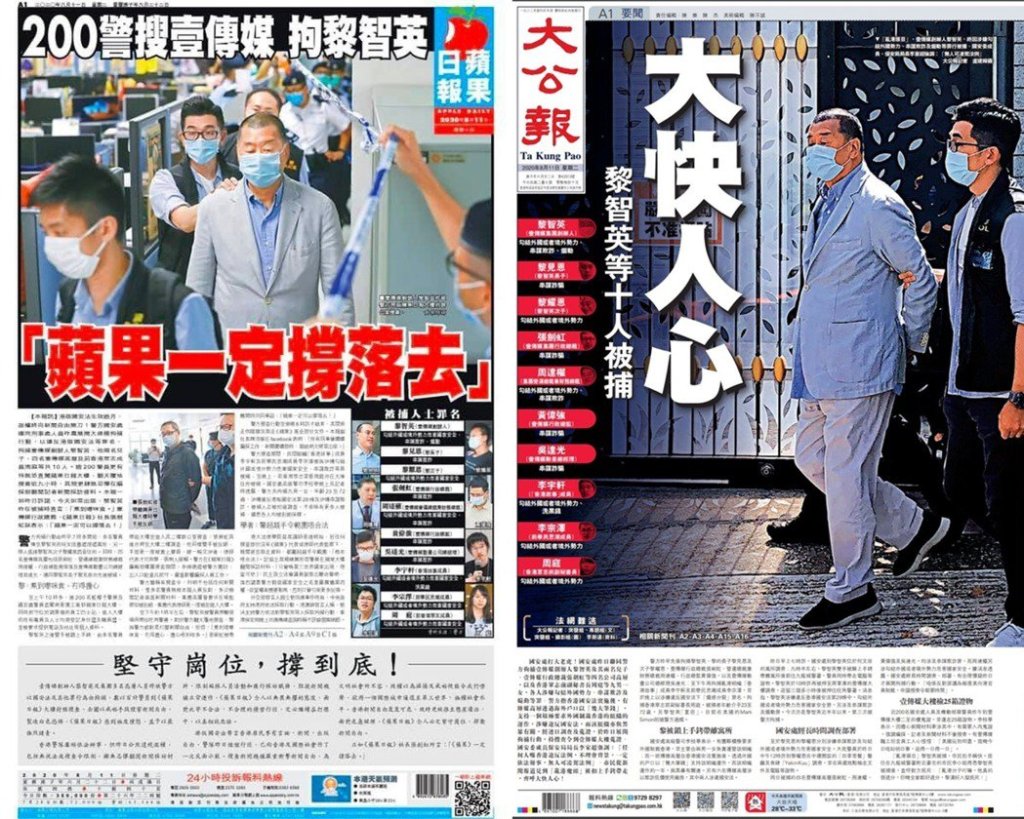
Owner of Apple Daily arrested, later on having led to shutting down of the whole media group
The environment now does not allow any outspokeness in relations to the protest, even writen material is to be distributed with extra caution. I would like to take the time here to just express that the project to this point is in it’s nature documenting what has happened, how electronic media has changed due to the events of 2019. In my opinion, the protests were over done and there is a strong belief that foreign powers were at play in fanning the flame in esculating the anger of protestors in to (I would have to admit) an angry mob. No matter what caused it and how it ended, the people of HK needs to now settle down and think past all the turmoil.
In my opinion, it is important to accept the fact that the handover has happened and that Hong Kong is experiencing a shift in power that might not fit well with part of the population. Staying safe to see another day is one thing, and now the most vital is that HK’s core values (as mentioned by Jenny) needs to be realised. Culture is one thing that laws does not have a steady hand on and that there is a safe way in experessing our opinions, preserve our unique history and identity, but most of all is to look forward and figure out the steps ahead of us as Hong Kong people, how are we to make a mark on the Chinese map? The globe? What was and will be our advantages?
Remember me having had a chat with FJ during week 2? I have had the chance to sit and have had a proper interview with him this week.
As it turns out, his proper name is Damon Chui, and as mentioned before he has been part of the Electronic News Gathering (ENG) crew for HK Cable TV news team from 2010 to around 2018.
DC = Damon Chui ME = Andy
ME : Do you think that journalist teams hold political biases?
DC : Most of us share a common bias but as professionals we will not express our opinions while on the job.
We are suppose to document and record history and events, it is not up to us to judge right or wrong. The consequences of altering the archive could have a long term effect : What seem true now might not withhold after a decade or two. That is how news reporting originated, very neutral non-judgemental wordings and tones simply just reporting an event.
Here’s an example of how wording could make a difference to an event:
A car knocks down a pedestrian, it was proven that the driver ran a light (neutral in tone, raw portrayal)
A Ferrari speed through traffic and almost kills a lady aged 70 (suggestions of statues, moral conduct and victimising subjects)
ME : About the graphics that they use while the news anchors are reporting, are they planned at all is there a method behind them?
DC : The chief editor is in charge of those. 2D drawings/graphics usually are used for smaller, less significant news segments ; you would know it is an urgent, major news event when the graphic is a screen capture of a live event, which creates a sense of urgency and the feeling of it being an instant event.
ME : How is the order of news reporting determined?
DC : Juicy, local news are always at the beginning of the show, there is a reason why sports and the weather are always placed at the end. If we look at the level of excitement as a curve, it is most certain that news shows kick off at a high note in the beginning and gradually move down from there, this is in place all according to the news habits of Hong Kong viewers, one better catch their attention in the first 15 minutes in order for them to continue on for the remaining 15 minutes of the news , and now that attention span is even less.
Every news editor does grasp this pattern in slightly different ways, but a good editor is always one with years of experience in the industry.
ME : Lets compare TVB (pro-gov) and Cable TV News (more leftist), are their show peaks different?
DC : Now much difference in content but the significant differs in context and how they script their segments.
ME : Audio, Visual and Wording, how would you rate the importance of these for a news show?
DC : Humans are visual animals, only with interesting visuals would the audience pay attention to what is being said.
ME : What is a “real shot”?
DC : “Brother Sing” of Stand News for example : I respect what he is doing (cameraman turned celebrity anchor/host), but he is a “ shot creator”. You are supposed to describe an event and not fan emotions on location (the police). Yet what he did during the demonstration was getting positive feedback from social network and when there is a demand there follows more radical behavior.
So he’s there making news instead of documenting it.
What I was taught in school was that we as journalists use evidence in portraying an event instead of being guided by emotions. But now smart devices and social media has opened up both ends of reception and it is only natural that someone would hear opinions and is set to feed those needs, its only natural with the introduction of technology.
ME : How can news be exaggerated and amplified?
DC : By editing segments, selecting interview content and news content, editing them in a way which would express personal opinions. Old news networks like TVB would used to report opinions on both sides of a spectrum but that is gone now, there was never right and wrong in news and viewers would make up their minds for themselves, but that is slowly changing now.
For example : Reporting on housing problems of the population in poverty in an analytical segment, BUT not researching and reporting in to the reason why these people are in poverty or jobless in the first place.
News is supposed to teach the public about ways to solve problems within the city, provide hotlines and introduce departments that could provide help to those in need. So yay, news nowaday is lacking that educational value also.
Reflection
It was really interesting having talked to William Pang who is very traditional inside out, Moment Hung who embraces all the new methods and now Damon who is a little bit of both. What’s most beneficial to this interview is that I have came to discover that Damon was the only interviewee I had who was trained as a journalist in school, so all these insights I have gained and the school of belief he has communicated looking back at this interview was pretty much Jounalism 101.
Damon Chui’s insights into the newsroom has really given me a better understanding of how news is generated both past, present and what the trends are right now.
For the weeks to come, I have lined up several interviews with people that have worked in the Hong Kong news industry and/or was involved with the demonstrations in 2019/2020.
On a side note, translating interviews take time, and after inquiring with several staff of Falmouth University there is no clear answer on how to handle material in a foreign language. So what I am prepared to do is to translate all the passages on my own and to send a copy back to the interviewee for their signed approval. Especially dealing with content that could be sensitive nowadays, there is a need to take precaution in assuring safety for both sides. Yet again, I am to steer away from politica mentionings as hard as I could.
For this week I have translated the interview I had with Moment Hung (to be referred to as MH). An active civil journalist who has spent years working for New Ears Music, a music / entertainment branch of HK01 and the following are some of the highlights.
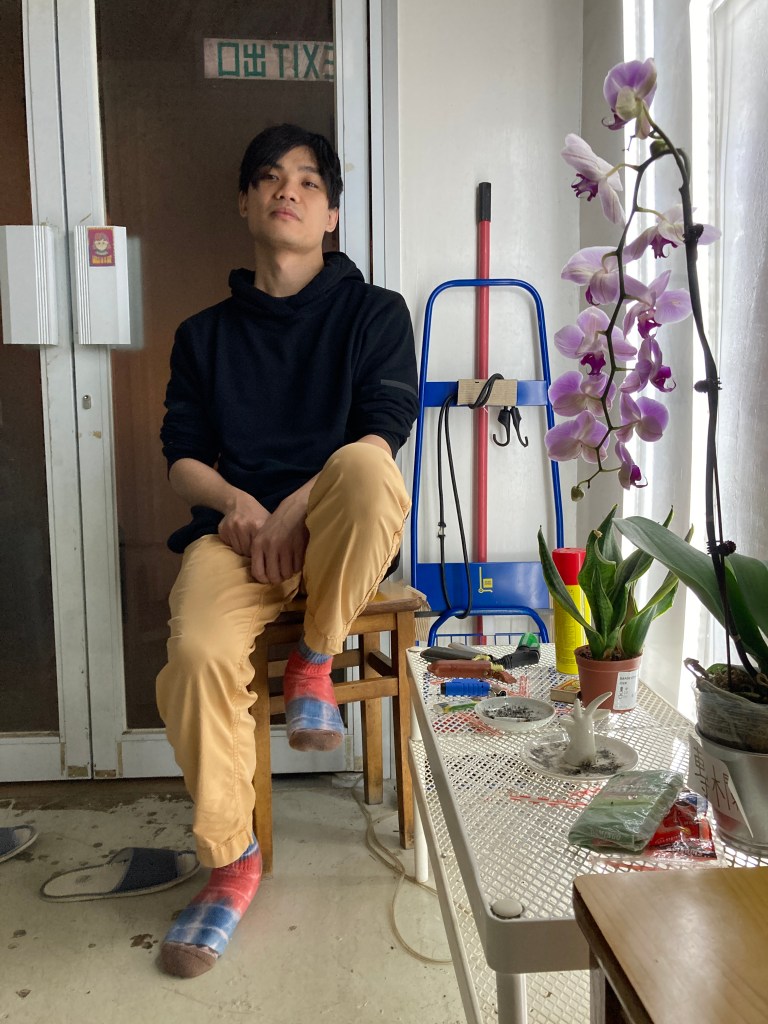
Moment at Kwai Cheung industrial district, studio and living space
MH = Moment Hung ME = Andy
MH : I actually consider 2019 as a great time, it brought many of us together into cultural groups and people were actually meeting each other and agreeing with each other. A rare occurrence compared to a normal state.
A : During your time working for New Ears Music, were you in conversations with the public regarding feedback towards the platform or any other comments?
MH : There is a huge judgemental issue (known to be a common trait of Hong Kong citizens). Being under HK01, one of the biggest news media firms in HK, people doubt our sincerity in doing good for indie-music and the HK music scene in general. But I have always held a belief in which I mean musicians and bands do no harm and tell it as it was.
Over the years I was working there, I have also developed the habit of looking in to negative comments made by haters, I feel like I have the right to put up a debate and explain to people that might have misunderstood my / our intentions.
An interesting case which I was involved with and the popular app Clubhouse (chat rooms are created based on specific topics, and that a huge amount of people are able to join in these discussions in the form of voice messages).
One time a noise complaint from a band practice studio was picking up steam and became a hot topic, there are those that are in support of the band and vice-versa. What happened was I got in touch and lined up local area authorities, the landlord of the studio, neighbours, people living close by etc. I then basically hosted this massive conversation on Clubhouse in efforts to resolve the issue and was met with a happy ending where everyone came to a mutual understanding.
The interesting side to this whole happening was that it was ALL logged in forms of convos, Facebook and Instagram messages. Everyone made comments and suggestions as they pleased in the efforts of resolving the issue.
So this was a great example of an issue / piece of news being spread and catching attention all over social media, people taking matters into their own hands and ultimately resolving an issue. News has evolved a new function in informing the public so that people are able to take action.
A : As a content creator, which aspect of a post do you think is most important?
MH : The concept. How the whole idea is presented and framed is most crucial. Creativity was much needed to attract viewer’s attention especially when we were more entertainment focused.
A : What are your thoughts about the news you see in Hong Kong?
MH : The mainstream news ceased producing any pulse, all timelines and recaps of event happenings are done by civilians. Everything was happening too quickly at the time (2019) which is a hot bed for fake news and vague reporting.
Live broadcasting is a good method of reporting, but the problem lies with people choosing to only watch the highlights and recaps on the mainstream news, often coming to quick conclusions without fully understanding certain situations.
The other problem is that nobody is willing to write long articles due to how inefficient it is for a blogger, even if long pieces are done hosts would much rather break them in to parts upon release. The same goes with video content, go longer than a minute and you will lose your viewer’s attention.
A : Any news platforms you personally prefer?
MH : I would have to say Clubhouse, it is instant while enabling people to directly communicate with one another. There is difficulty in proving the legitimacy of any information obtained in such a way, yet discovering news this way and coming to conclusions in a collective manner is a very civil journalistic thing to do.
A : Do you consider Clubhouse as a media platform?
MH : Yes. Traditional media platforms work in frames, and I guess every chat room in Clubhouse is their own frame.
The environment has changed, the traditional media still serves it’s function of informing the general public, but in an open platform where no rules or laws apply the communication is more primal, edit free and without time restrictions.
1 The following are the advantages of a new media:
2 Better for understanding an event and people’s feelings.
3 Viewers are now most accustomed to this form of receiving and delivering, which has more draw compared to traditional media where topics are only discussed by one set of individuals.
4 Targeting a specific audience means not pleasing everybody, which is way more effective than wasting time trying to persuade people with opposite opinions.
It’s a really big contrast compared to William Pang from last week who was trained and worked with many traditional journalist values. To meet someone who embraces the new scene and is very much active on social media brings a new perspective and outlook towards the future of how people are to obtain information and news, but also expressing their opinions and to act on certain conflicts within their community.
To link this weeks findings with previous reading and interviews, it’s concluded that the citizens of Hong Kong are having major doubts and are choosing other alternatives as their source for news and information, that said the events of 2019 have resulted in the parting of major social media platforms and communication apps, more so the improvised methods by utilizing functions in smart devices. This being one of the major ripples of post 2019 protests deserves a closer look.
Reflection
It’s a really big contrast compared to William Pang from last week who was trained and worked with many traditional journalist values. To meet someone who embraces the new scene and is very much active on social media brings a new perspective and outlook towards the future of how people are to obtain information and news, but also expressing their opinions and to act on certain conflicts within their community.
In retrospect, I held the feeling of negativity walking out of Willaim’s studio a couple days prior and on the flip side ; there is hope and much to explore from talking to Moment.
Coming to think about it though, I need to distant myself from the emotions that are communicated through these interviews and construct my perspective based on content on it’s own. In order to do that, I find translating the content while it’s fresh is of help : emotions and tones of the interviews themseves seem to fade away with documentation, as if being filtered in the process and that is when actual facts and information would surface.
To link this weeks findings with previous reading and interviews, it’s concluded that the citizens of Hong Kong are having major doubts and are choosing other alternatives as their source for news and information, that said the events of 2019 have resulted in the parting of major social media platforms and communication apps, more so the improvised methods by utilizing functions in smart devices. This being one of the major ripples of post 2019 protests deserves a closer look.
For this week I was fortunate enough to have had an interview with William Pang (later on referred to as WP), a personal friend and veteran Electrician turned Programmer and later on Camera Operator during the 2019 protests. Here are some conversations I have translated from our 1 hour interview.
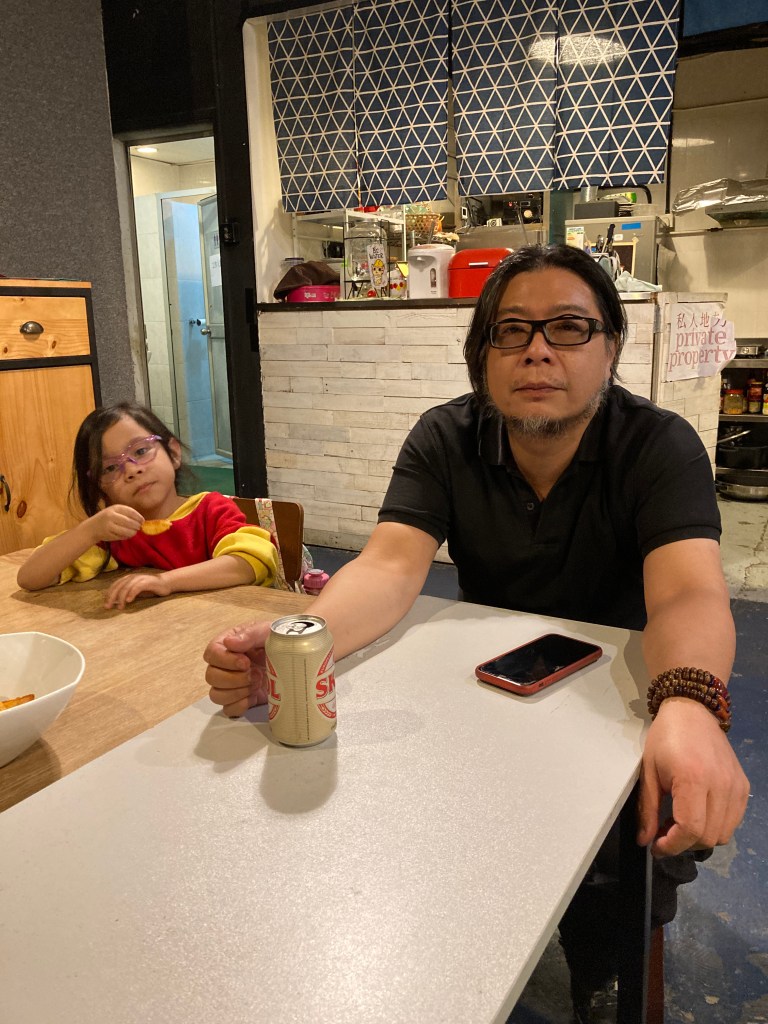
William and his young daughter at SAAL Kwun Tong, live house / venue / studio space
WP = William Pang ME = Andy
ME:
How did you end up becoming a journalist during the demonstrations of 2019?
WP:
I was not officially trained as a journalist, so I could only be referred to as a camera operator. There were not many of us at Local Press HK, and when things got heated in July and we were short of hand, I was invited to “tag along with” to hold a camera and do live coverage.
ME:
How long has online news been around for here in Hong Kong?
WP: Online news/media proceed the KOLs. It was first popularised with the wider use of the internet and was even more so with the usage of smartphones later on.
Online talk shows were the first to appear, but in the beginning most of them surrounded leisure related topics and lacked news value. It was until the “Umbrella Revolution” of 2014 was when online media started being news and politically driven.
ME:
In your case, before you were sent out to cover the protests live, was there a briefing or a guideline of news reporting ethics, dos and don’ts?
WP:
When we were present at a protest we are not suppose to express any opinion or bear any kind of badges that might suggest opinions, we are also extremely mindful of what we say when broadcasting live.
We were there for the soul purpose of archiving, our team was not weary of gaining viewers on social media or any sort of marketing.
To quote a colleague of mine : We are to stay in line (as reporters), but defend yourself when necessary.
Now a days, news media groups tend to send KOLs to cover stories, and they obviously do things differently compared to the traditional reporter.
ME:
Journalists and Camera Operators of online news media groups alike now interact a lot with users via the comment’s section, what are your thoughts on this?
WP:
I started working in this industry a long time ago, and I have followed the old ways of remaining hidden as a reporter, it was pretty much an industry tradition to remain “invisible”.
News anchors started gaining “character” when local news networks started competing with each other (mainly TVB and ATV), but even back in the “silver age” of television, the staff behind the scenes of the newsroom remained unknown. I believe the trend of celebrity anchors started in Japan (in Asia at least).
For example : Sing of Stand News, who started off as a camera operator and has now established himself as a reporter, has risen to such status due to popularity. A dramatic change that has led to feuds and debates inside the newsroom.
ME:
Any pros and cons to these changes you think?
WP:
In my opinion this is not healthy at all, without proper training in journalism a lot of vital news information was not (and still is) not communicated thoroughly. The way of reporting having shifted to this state is inevitable, the problem does not lie in the anchor’s fame, but in the fact that they are adding in personal opinions.
Reflection
My thoughts on this interview is that there is a new trend in news reporting and it is happening nowhere near a television set, the traditional networks or even the most fundamental guidelines and morals of the classic journalist is fading.
There is no stopping how smartphones and tech are introducing new ways in delivering messages and news. With every channel owner, blogger and KOL creating content that is designed to satisfy Hong Kong’s culture of fast, direct and group targeted, with hit rates being the critical survival factor for these outlets, in other words: the viewers are directly influencing the content that is being released online.
Involvement and opinions have no boundaries on the open world of smart devices. While some might take this in a bitter manner we are all aware that there is no turning back and it is just how the world works now. In taking this trend in a positive manner, the pros and the cons of these methods are to be analyzed, to maximize the efficiency and legitimacy of content being passed around and to raise awareness of responsible use of these technologies.
There were many quick unexpected changes here in Hong Kong in 2019/2020, now that the whole situation is relatively under control, it is time to look at current situations, what are the problems in communication and passing of critical news, and with the tools of graphic design to find and suggest solutions in hopefully being able to settle the gaps and confusions left behind by these events.
Reflection of Interview Techniques
I was well prepared with a set of questions before knocking on William’s door, but there are a few things in which I discovered:
1 : The questions are nice to have, but most often the topic would sway in unexpected turns and could render the rest of the list of questions useless.
2 : The flow and tone of the interview could shift depending on the setting, for example : William’s daughter being present could create small distractions here and there.
YET with the relaxed atmosphere and having cracked open some beers has really changed the tone of the interview after listening to the recordings. I walked in expecting a proper question and answer session and yet it ended up just another day talking with my friend with swearing and laughs along the way.
I think I am a rather proper person when the “work mode” is on, but then in order to make the interviewee feel more relaxed and let more personal thoughts flow, making them feel friendly despite being friends in the first place or not is something I have learnt to cope with and enjoy.
Of course not everyone is up for a beer and would allow ample time to have a “chill” interview, for example : in the last module: it was during the pandemic when interviews had to be conducted over the phone, and some interviewees (I having approached them as a student conducting research, a total stranger), were seated in their office a little while after lunch, and the tone of those would be something simular to what you would hear in a news special.
Before each interview, identify the : location, setting, my relations between the interviewee, their personality / behavior, be prepared but expect sudden shifts in between and be ready to react, listen , think while keeping a note pad handy while interview in progress to revisit interesting points as the interview goes along.
In order to get more insights to the news industry in Hong Kong, I had to go book hunting. There aren’t many book shops left in Hong Kong, so I first visited Eslite, a bookshop which originated in Taiwan.
No luck finding any titles related to Hong Kong journalism, but then I managed to pick up Merchants of Truth : Inside the News Revolution by Jill Abramson, former editor of The New York Times.
Plus I found out that Jamie Hewlett (my hero) has released a a new book filled with his artwork, I could not resist!
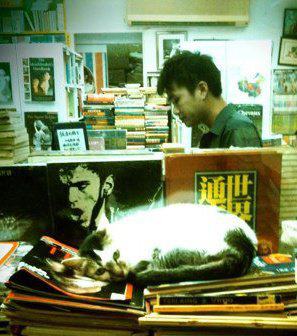
So then I went to my go-to bookshop Sam Kee, a place known for fostering cats and a massive collection of books old and new.
A photo a friend took of me inside of Sam Kee some 8 years ago
There is a section on news and media in the 2nd hand section. It was a great find, after flipping through all 10 of them I made my selection :
One problem remained though, these books date back around 8 to 10 years ago, they seem like they could still be a good read in to the HK news industry, but that my topic is to look in to something more recent, so I went over to where they sell new books.
Aside from sidetracking and picking up a book documenting neon signs of Hong Kong, most new books bear titles such as : After the Revolution, Is Hong Kong Free?, and so I picked a chat with one of the shop owners and found out that it has been the trend for book publishing in the past year : most writers base their publications on politics or doubts about the Chinese government. “Are there any titles about the news industry?”, he kindly dug into a pile for a while and announced that there WAS a Chinese copy of Fake News but someone must have bought it.
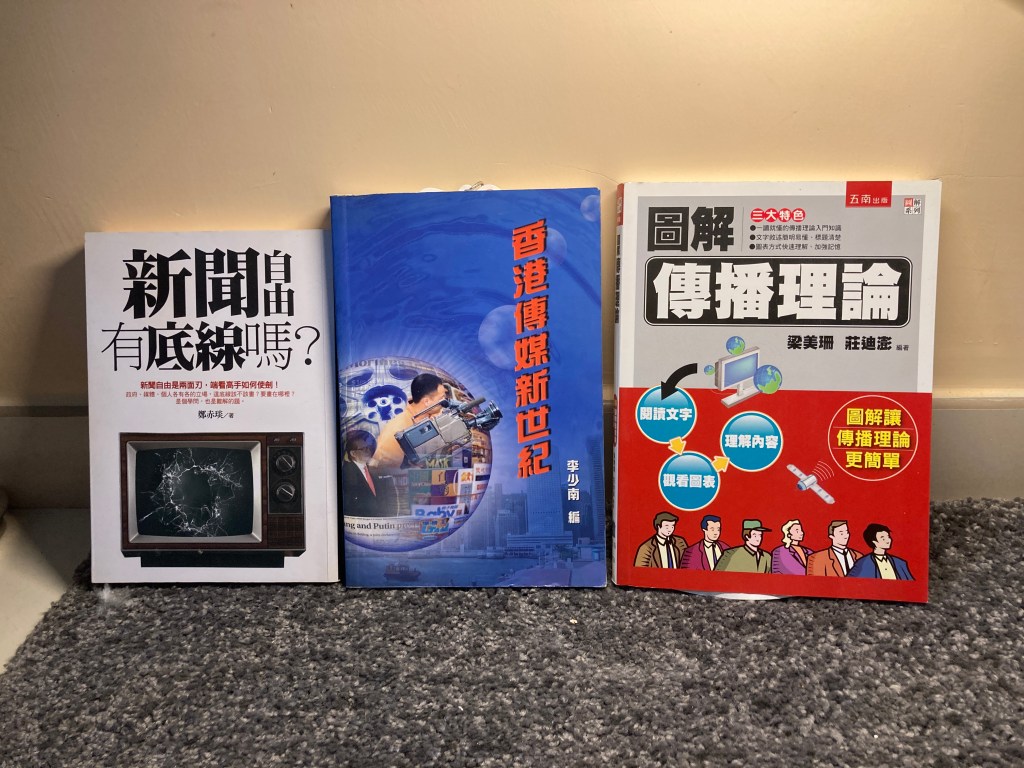
from left to right : Is There An Underline to Freedom of News?, Hong Kong Media New Age,Illustrated Theory in Broadcasting
Most of these publications were published in the early 2000s and that it is understood that many of the content could be outdated with the rise of the smartphone + the shift in the political atmosphere in result of the Umbrella Revolution of 2014 and the Anti- Extradition Bill Protest in 2019, but I think that this material is still worth a quick read through in understanding how the news and media function here in Hong Kong in a traditional sense. From my experience in the past modules, this could help raise querstions in comparing traditional values with the new and hopefully result in interesting conversations and thoughts in future inter views and research.
So in the coming weeks I will continue my search for the right books, meanwhile Ill be digging in to the books on hand to see what I can learn from them.
I have also remembered a friend working as Chief Editor for 01News and am planning to get in touch with him after the Chinese New Year holiday.
I was told by many spiritual people about the Law of Attraction : when you are in tune with the universe you will attract the people and happenings you need.
So I was just sitting at home, and my girlfriend told me that a friend is coming up to just pick up a few things, I was like ok.
The 2 have met during what was known as the Umbrella Revolution in 2014, when my girlfriend was part of the demonstrators whom blocked off a major financial district here in Hong Kong named Central (and parts of Admiralty). So they had lots of catching up to do while I sat aside just watching TV.
Just when they were done chatting, I joined in on the conversation which started off with something about music. Then I asked “So what do you do for a living?”, and this guy replied me “ I was a cameraman for the Cable News Network for 10 years and has recently left.”.
So yes, marched right in to my home and I told him what I am up to for the FYP.
Fong Jeurng
Fong Jeurng means head monk (a joke derived from Stephen Chow movie God of Cookery), I never asked how he got the nickname and that I yet to confirm his true name. So in the following I shall refer to him as F.J.
Fong Jeurng from film : God of Cookery 1996
We talked for an hour. No audio was recorded because I was not even prepared, but so I just shot around and fired any kind of questions of interest regarding his 10 years as a news reporting crew. Him having studied journalism, he basically gave me a journalist 101.
What are the basic beliefs in journalism? (I asked)
FJ:
Having been taught in school, the duty of a journalist is to leave personal opinions aside and only provide the facts for the viewer to develop their own opinions.
That’s why wide angle shots are considered the most just and fair technique in news reporting.
You having said that you have covered dangerous situations such as the Philippine(Manila) Hostage Crisis in August 2010, you guys must’ve been paid a lot?
FJ:
No! We are only paid an average salary of around $15000HKD a month(around 1400 pounds). The job is really demanding with us having gave up on a normal social life, but we were driven by passion and a sense of responsibility as news workers.
Imagine, being told to fly out at 4am on a Saturday to do a coverage, we always have our bags packed with our passport ready. Back in Manila, a bullet landed just right beside my foot and our crew had to just brave it out and get the job done.
So no, we don’t get paid for all that we risk and have to give up, but journalists here love their jobs and that is what fuels the industry.
Why did you leave your job after a decade of working for Cable TV News?
FJ:
There was a shift in management that was clamping down on what we are supposed to report, my boss left and most of the staff left with.
The news industry is very different now, deals were made with foreign networks to provide live footage of events and the only thing left for us to do is to cover local happenings, eliminating the need to house the amount of staff that was needed.
What do you think about the quality of news reports in Hong Kong now?
FJ:
The reports are too vague and that there are not enough news documentaries to give in depth insight of a happening to the public. It impacts people’s opinions for they assume they’ve understood what actually happened after watching the news, but in fact a lot of details were left out due to production, people’s attention span and limited air time.
Networks are not willing to put in the resources to produce such shows also, it takes months of research, someone has to script the whole segment, pre and post production are way too time consuming and expensive.
FJ has agreed on taking a fully recorded interview in the coming weeks, really looking forward to getting more insights from him.
What I Should’ve Done
Looking back at this first encounter we had, all I needed to do was ask and then with one press of a button I would’ve had a better idea of what to ask and re-visit for the official interview.
I think it’s important to keep in mind that documentation is vital for a project in progress, and having missed a moment like this means picking up pieces by memory and that important information might have been lost forever or left un-mentioned later on.
So the lesson here is : record while you can and think later.











 ANDY was here 🤓